
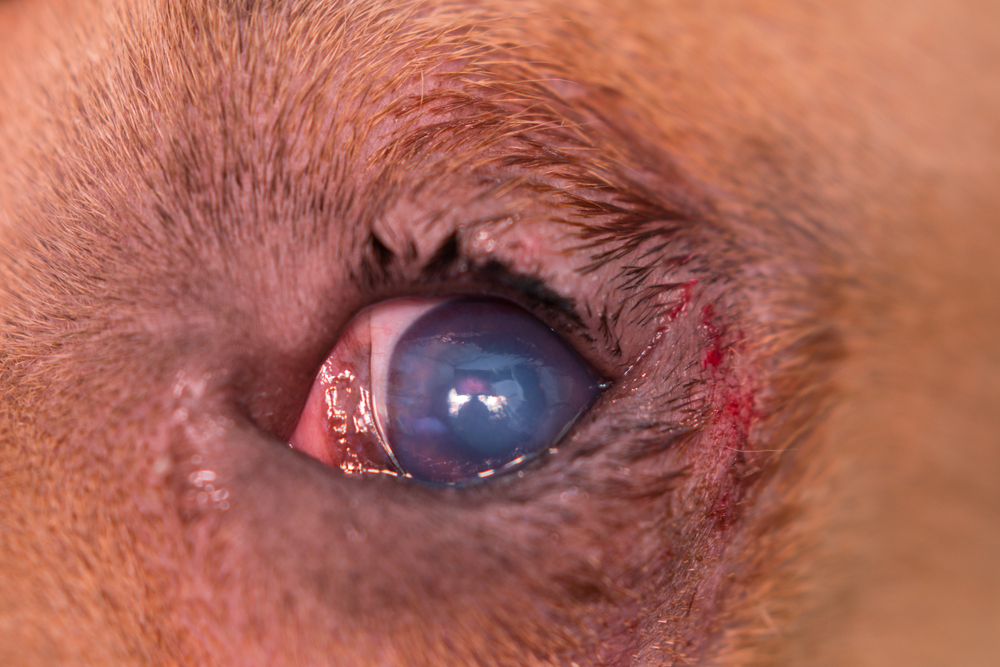
An eyelid that rolls toward the eye (entropion) or hangs loosely away from it (ectropion) does not automatically mean an immediate trip to the operating table, because age and severity change the right answer. A puppy or kitten still growing into its face can often be managed with temporary tacking sutures that hold the lid safely in place while the skull matures, and some outgrow the problem entirely. Mild ectropion that stays clean and comfortable sometimes needs nothing more than monitoring. When a lid is rubbing the cornea or leaving it exposed, though, permanent surgical correction is the fix that lasts, and results are excellent when it happens before the surface of the eye scars.
Working dogs, barn cats, and couch dwellers all face this same fork at Lewiston Veterinary Clinic, and we help you weigh it honestly. A thorough eye exam tells us how much the lid is actually hurting the eye, and our soft tissue surgery options run from temporary tacking sutures for a fast-growing puppy to permanent lid correction for an adult dog or cat. When one eye keeps squinting, watering, or getting pawed at, give us a call and we will help you sort out which path fits your pet.
Eyelid Trouble: The Basics
- Entropion rolls the eyelid inward so lashes scrape the cornea, while ectropion sags it outward and exposes the delicate inner lid.
- Breed and facial structure drive most cases, so certain dogs and flat-faced cats carry higher risk from birth.
- Squinting, tearing, pawing, and a held-shut eye are pain signals worth an exam, because a rubbing lash can wear the eye into a scarring ulcer.
- Correction ranges from a few temporary stitches in a growing puppy to permanent surgery in a mature pet, and outcomes are excellent when we act before the cornea scars.
What Exactly Is Happening When an Eyelid Rolls In or Sags Out?
Think of the eyelid as a snug little windshield wiper that’s supposed to sit flush against the eye. When it sits correctly, it helps protect the cornea from irritants and spread tears to help the eye stay lubricated. No fur should touch the eye.
With entropion, the lid rolls inward, and the lashes and fur that ride along its edge scrape across the cornea with every blink. That constant friction makes the eye red, weepy, and painful. It’s a mechanical problem, not an infection, though infection often piles on later.
Ectropion runs the opposite direction, turning the lower eyelid outward so the pink inner lid is left exposed to dryness, debris, and repeat irritation. It’s like a gutter that no longer channels tears where they belong.
Here’s the tricky part: several eye issues look alike from the outside, and a squinting eye can point to a scratch, a foreign body, or a painful lid all at once.
Is My Dog’s Breed More Likely to Have Eyelid Problems?
Some pets really are born with the deck stacked toward eyelid trouble. Most eyelid disorders trace back to facial structure and inherited skin conformation rather than anything a family did or missed. Loose skin, deep-set eyes, heavy brows, and flat faces all tug the lids out of alignment.
Risk tends to cluster in specific groups:
- Dogs prone to entropion: Breeds with heavy facial folds and deep-set eyes, like Chow Chows, Shar-Peis, Bulldogs, Rottweilers, and many mastiff types, tend to roll the lid inward. Hereditary eyelid conditions pass down through breeding lines.
- Dogs prone to ectropion: Breeds bred for a loose, droopy lower lid, such as Bloodhounds, Basset Hounds, Saint Bernards, and many spaniels, sag the lid outward. Some giant breeds show a bit of both on the same eye, a combination sometimes called diamond eye.
- Cats: Persians and other flat-faced breeds carry the same risk, because a shortened skull leaves less room for the lids to sit flush against the eye.
Breed isn’t the whole story. Age-related loss of muscle tone, chronic inflammation, scarring from a past injury, or a pet squinting so hard from pain that the lid rolls in can all bring these conditions on later in life. If your dog or cat is on one of these lists, routine wellness exams are a good place to ask about lid position before a problem ever starts.
When Does a Squinty or Weepy Eye Need Same-Day Attention?
An eye that stays squinted, waters constantly, or keeps getting pawed at is telling you it hurts, and that deserves a same-day look rather than wait-and-see. The signs below point to a lid that’s actively working against the eye, and the longer that goes on, the harder the eventual fix becomes.
Watch for these signals:
- Pain behaviors: Squinting, pawing at the face, excessive tearing, and holding an eye shut are all signs of eye pain, not cosmetic quirks to wait out.
- Surface damage: When lashes and fur rub the eye surface unchecked, they wear it down into corneal ulcers that can scar the eye and put vision at risk.
- Discharge changes: Watery streaking that turns thick, yellow, or green often means eye discharge has moved from simple irritation toward a secondary infection.
The two conditions fail in different ways when they’re left alone. Entropion tends to cause the scary problems: ongoing corneal abrasion, ulcers, pigment and scar tissue creeping across the eye, and in bad cases a real threat to vision. Ectropion is usually less dramatic but still miserable, driving chronic dryness, recurrent conjunctivitis, and infections in that exposed pocket of inner lid. Either way, a cornea that has already scarred doesn’t fully un-scar, so catching things early changes the outcome. Around here, dry summer air, wind off the river, and dust and cheatgrass on a working property all give an already-irritated eye more to fight. If your pet is showing any of these signs, it’s time to have the eye examined.
How Do You Figure Out What’s Wrong With the Eyelid?
Diagnosis starts with how the lid sits and moves, then confirms what the surface of the eye has been through. A handful of quick ocular tests measure tear production and highlight damage a normal-looking eye can hide.
A typical eyelid workup includes:
- Lid position and blink check: We watch how the lid rests and rolls, in good light and with the pet relaxed, to see the malposition in action.
- Corneal staining: A harmless dye highlights scratches, ulcers, and rough spots that are invisible to the naked eye.
- Tear testing: A quick strip measures whether the eye is making enough tears, which matters a lot for an exposed ectropion eye.
- Lash inspection: Part of the exam checks for eyelash problems like extra or misdirected hairs, which can mimic entropion or ride along with it.
- The anesthetic test: A drop of topical numbing medication tells us a lot: if a rolled-in lid relaxes to normal once the pain is gone, the squinting was driving it (spastic entropion); if it stays rolled, the problem is structural and surgery is the durable answer.
What Are the Treatment Choices, From a Few Stitches to Full Repair?
Treatment runs along a spectrum, from a couple of temporary sutures to permanent surgical correction, and the right spot on that spectrum depends on your pet’s age, species, and how much the eye is suffering. Picking the least invasive fix that solves the problem is the whole art of it.
| Approach | Best suited for | What it does |
| Monitoring | Mild, comfortable ectropion | Watchful waiting with lubrication as needed |
| Temporary tacking | Growing puppies, kittens, pain-induced rolling | Buys time until the face matures |
| Permanent surgery | Mature pets with structural malposition | Lasting correction of the lid edge |
What Are the Temporary or Short-Term Fixes?
Sometimes the right fix is temporary on purpose. For a growing puppy or a pet squinting from pain, temporary eyelid tacking uses a few sutures to hold the lid in a normal position until the anatomy settles. The stitches roll the lid gently off the cornea, giving the eye relief without committing a still-changing puppy to permanent surgery.
Tacking can be repeated if a young pet needs a little more time. Alongside it, we often send home a lubricating ointment or antibiotic drops to protect the cornea and let any existing scratch heal while the lid is held out of the way.
What Does Permanent Surgical Repair Involve?
When the lid problem is clearly structural and the pet has finished growing, corrective eyelid surgery removes and repositions a carefully measured amount of tissue. A conservative approach matters because overcorrection creates its own problems: take out too little and the lid still rolls; take out too much and you’ve turned an entropion into an ectropion.
Our team tailors the technique to your pet’s condition, species, and anatomy, which is why the measuring before the first incision matters as much as the surgery itself. If your dog competes in shows, check your breed registry’s rules first, since some have policies about corrective eyelid surgery worth knowing before you schedule.
Is Feline Entropion Different?
Unlike the young purebred dogs we often see, entropion in cats tends to show up later in life and often travels with other eye-surface disease, so feline cases sometimes call for more than one technique at once. Chronic herpesvirus, scarring, and a shrinking eye can all pull a cat’s lid inward, which means the repair has to address the underlying trouble too. If your cat is squinting or holding an eye shut, reach out so we can look at the whole picture.
What Actually Happens on Surgery Day and During Recovery?
Surgery day follows a calm, predictable rhythm, and knowing the steps ahead of time takes a lot of the worry out of it. Most pets go home the same day, a little sleepy but comfortable.
Here’s the general arc of the day:
- Before we start: Pre-anesthetic bloodwork runs in our own lab so we can confirm the organs are ready to handle anesthesia, then we recheck the lid, confirm the exact plan, and go over pain management with you.
- During surgery: A trained team member watches vitals continuously while the surgeon places sutures with a conservative, measured hand.
- Waking up: Your pet recovers in a warm, quiet space, and grogginess for a day is completely normal.
What Do the First Few Days at Home Look Like?
The first few days are about protection and patience. Some redness, mild swelling, and squinting are normal and ease within a few days; what warrants a call is worsening swelling, discharge that turns thick or bloody, a lost suture, or a pet who seems to be in more pain rather than less. The single most important job is keeping the Elizabethan collar on at all times, indoors and on every walk around Lewiston, because one good rub against the carpet can undo delicate work in a second.
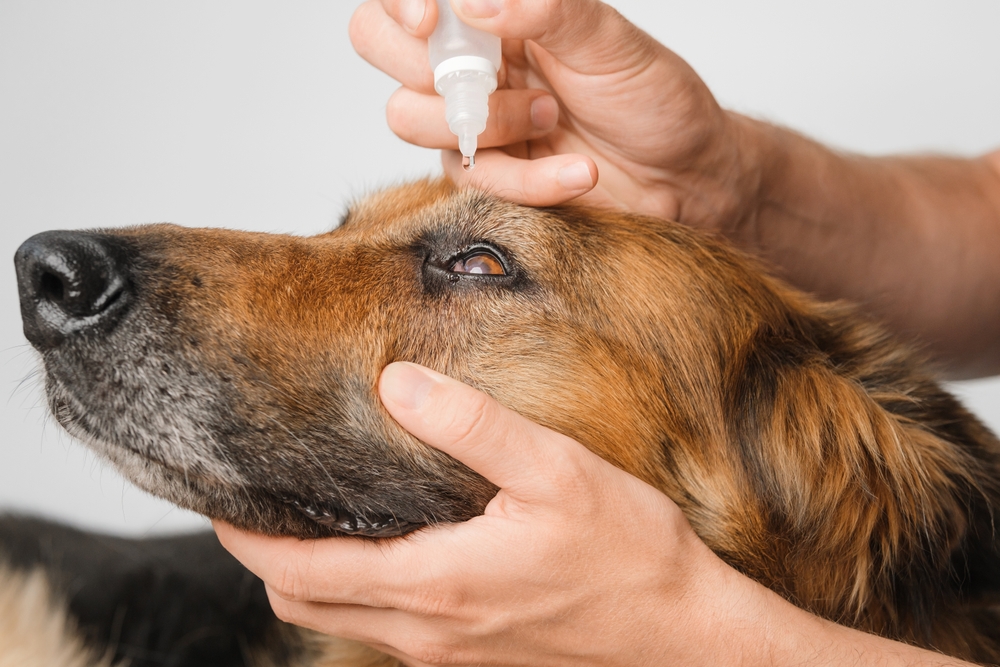
Give medications on the schedule we send home. Administering eye medications goes easier when you tilt the head back, steady your hand against the skull, and let a few minutes pass between different drops. If something looks wrong after we’ve closed, our after-hours on-call service covers weekday evenings and Saturday afternoons, and that call routes you to the clinic covering the rotation that night.
What’s the Healing Timeline?
Skin sutures usually come out around ten to fourteen days, and the lid keeps settling into its final position over the following weeks. We’ll see your pet for a recheck to confirm the cornea is healing and the edge is sitting where it should. Because we aim for a conservative correction, a small touch-up is occasionally recommended once everything has relaxed, and that’s a normal part of dialing in a great result.
How Well Does Eyelid Surgery Usually Turn Out?
The outlook is reassuring. Most pets wake up from a well-timed correction visibly more comfortable, and the relief of an eye that no longer rubs or dries out is often obvious within days. A single properly measured repair on a mature face holds for life in the majority of patients, and the eye that’s been squinting for months usually opens up and stays open.
A few factors shape the result:
- Severity and maturity: A milder malposition on a fully grown face is the most straightforward to correct cleanly.
- Starting eye health: Corneal scarring that formed before surgery may not fully clear, though we can still stop further damage and take away the pain.
- Home care: Faithful Elizabethan collar (cone) use and medication during recovery protect the repair while it heals.
Follow-up doesn’t end at suture removal; a quick look at the lid during future wellness visits helps us catch any late changes early.
Eyelid Surgery Questions Pet Families Ask Us Most
Will my pet’s eyelid problem come back after surgery?
For most pets, a permanent correction done on a mature face is a one-and-done fix, and the lid stays where we put it for life. The main exception is a pet operated on too young, before the face is finished growing, which is exactly why we lean on temporary tacking for puppies and kittens.
Is entropion or ectropion painful for my pet?
Entropion is typically the more painful of the two, because lashes and fur are physically scraping the cornea with every blink. Ectropion is often less acutely painful but brings its own low-grade misery through chronic dryness and repeated infections. Pets are stoic and tend to hide it, so squinting, tearing, or pawing usually means more discomfort than they’re letting on.
Is anesthesia safe for this kind of surgery?
Eyelid correction is a short procedure, and pre-anesthetic bloodwork plus continuous monitoring during the procedure are how we keep the risk low. Age alone isn’t a disqualifier; an otherwise healthy senior with clean lab work is often a fine candidate, and leaving a painful lid uncorrected carries its own cost. If your pet has a heart murmur, kidney changes, or another condition on the chart, tell us and we’ll build the protocol around it.
How soon should I have a droopy or turned-in eyelid checked?
Sooner is better, especially if the eye is red, weepy, or getting pawed at, since active corneal rubbing can scar the eye in a surprisingly short window. Mild, comfortable ectropion with no discharge is less urgent and can often be raised at a routine visit. When in doubt, a quick exam settles it.
Let’s Get That Eye Comfortable Again
Entropion and ectropion are among the more fixable eye problems we see at Lewiston Veterinary Clinic, and a timely, carefully measured eyelid correction restores comfort and protects vision for the long haul. If that squint or watery eye has been nagging at you, book a consultation and we’ll sort out the next step together, right here in Lewiston.



Leave A Comment